Pages

Showing posts with label airport security. Show all posts

Monday, July 7, 2014

News Update: Airline Security Tightens Overseas, Expedia Acquires Wotif Group and Tourists are Bound for Norway

Airline Security Tightens on Overseas Flights to U.S.

USA Today - July 7, 2014

© Chris Ratcliffe/Bloomberg
The Department of Homeland Security officials announced that security would tighten at airports where flights head directly to the U.S. The Transportation Security Administration said that as part of routine screenings at the overseas airports, officers may ask owners to turn on devices including cellphones. If those devices are dead or cannot turn on, they won't be permitted on the flight. The change is part of an attempt to anticipate the next attack. This comes as violence in Iraq and threats from al-Qaeda have become more of a concern.

MyTake: This is just another precaution taken by our country to avoid future terrorist attacks. Even though the additional security can be irritating, there hasn't been much criticism to it. I think most people are accustomed to these extra safety measures, and most people are happy to oblige in return for a sense of security. Just make sure you have your devices charged fully when you get to the airport.

U.S. Vacation Timeshare Industry has Banner Year in 2013

Hospitality Net - July 7, 2014

A new study found that the U.S. timeshare industry enjoyed significant growth in 2013. The study, conducted by Ernst & Young and commissioned by the American Resort Development Association, found that sales volume increased nearly 11% compared to 2012, average sales price rose 9% and there were 29% more resorts planned for the upcoming year. Occupancy remained steady around 76%. 

MyTake: The numbers don't lie, timeshare growth has made a comeback. The incremental growth has been going on for a while now, due mostly to more people renting out their properties, and travelers eager to have a different housing experience when they're on vacation. Hotels are no longer the first choice when booking accommodations, especially with websites like Airbnb and HomeAway offering great properties for a reasonable rate. Although timeshares may not be the most prevalent properties on those websites, it's clear that the success of the platforms is having a positive effect on the timeshare industry.

Expedia Acquires Australia's Wotif Group

Skift - July 6, 2014

Expedia Inc. agreed to acquire Australia's Wotif Group for $658 million, marking another major merger/acquisition in the online travel market. Wotif owns brands in the Asia-Pacific region like Lastminute.com.au, Travel.com.au, LateStays.com and GoDo.com.au, among others. The purchase allows Expedia to expand it's presence in that region of the world.

MyTake: Online travel companies are trying to bulk up their offerings, especially in international markets, as more and more people are eager to take long trips to exotic locations. Expedia's acquisition will help it expand in the Asia-Pacific region and help it grow it's global hotel business. This move comes after Expedia announced its acquisition of a small European car rental site Auto Escape Group. It will also help Expedia compete against Priceline Group, which just acquired restaurant-reservation site OpenTable in June. I expect we'll see a few more mergers/acquisitions in the online travel market as companies continue to add more platforms and give consumers more choices when it comes to travel.

Tourists Are Bound for Norway, Thanks to Disney

Travel Weekly - July 6, 2014

Unless you've been living under a rock, you know that Disney's animated film Frozen has experienced overwhelming success since it's release, creating a huge fan base of people eager to travel to the country that inspired the film: Norway. The country has experienced a major surge in visitors. Tour operators have reported anywhere between 20% and 40% increases in sales to Norway for 2014, and total arrivals from New York to Oslo in the first quarter of 2014 were up 57% from the year before. While the movie certainly got people excited about the country, Norway also played it's own role. It partnered with Disney to launch a global campaign to raise awareness about the destination. 

MyTake: It's pretty typical for a destination to take advantage of the popularity of a show or movie in order to attract travelers. Norway was incredibly smart to partner with Disney, a global powerhouse that is known in households all over the world. The success of the movie has not only prompted tour operators and the country of Norway to offer special packages, but Disney's own tour brand created an eight-day Norway itinerary to meet demand. The high level of tourists most likely has to do with the fact that the movie has garnered a very large youth fan base, and children play a big factor in trip planning. If they want to go see where Anna and Elsa live, then their parents will make every attempt to get them there.


Saturday, February 23, 2013

Budget Cuts Could Delay Travel

Federal budget cuts are due to hit airlines and airports in the last week of February, bringing a wave of delays, reduced takeoffs and slower security lines that may only get worse as the year goes on and more government furloughs go into effect.

Basically, the Transportation Secretary, Ray LaHood, said most of the Federal Aviation Administration's 47,000 employees would face one day of furlough per two weeks, which means about 10% fewer workers on any given day on average. Fewer air traffic controllers means less people to handle all the planes in the system. To manage the shift, the FAA would accept fewer planes in the system, the same strategy used when there's bad weather. This means larger mile gaps between flights, so passengers will be forced to sit on tarmacs of face delays while they wait for planes to leave the gate.

There are also expected furloughs of TSA workers, meaning longer security lines, and deplaning from international flights could be slower because Customs and Border Protection agents are expected to work fewer hours. Waits at security  could increase by up to an hour, and waits of four to five hours might be common for overseas travelers.

All the details are a little fuzzy, but things do not look promising for travelers over the next few months, and into the busy summer months. Especially with gas prices rising again. It is very possible that staycation could become another common trend this year.
http://www.nytimes.com/2013/02/22/us/government-says-cuts-could-cause-air-travel-delays.html?ref=business&_r=0&gwh=8498274940743D072FA86307E5FD2763

Monday, December 3, 2012

More Fees? Or Just Different Ones?

Source: LA Times
Airline fees have become commonplace in the world of travel, it is difficult to remember a time when they did not exist. Ever since the terrorist attacks on September 11, 2001, the air travel culture has dramatically changed. Now, we are so accustomed to long security lines, taking shoes off, and standing in an ominous revolving scanner, it is second nature to perform all these tasks. We are unphased by all the security protocols. But one area people still have trouble accepting is the growing number of a la carte fees that airlines serve up.

According to a recent article in The Los Angeles Times, the world's largest airlines are expected to make $36.1 billion from fees. This includes food, drinks, wireless internet, priority seating, more leg room and checked bags. Some airlines even charge for checking in online, carry-on bags and expedited service through security check points. But it does not end there. At the Airline Information conference in San Diego, representatives from various airlines discussed ways to maximize the fees they charge passengers.

There was some talk of different travel insurance offers or letting passengers pre-order on-board meals and snacks, a move to reduce uneccessary spending and waste from leftover meals. One of the biggest trends, though, is basing fees on data collected from past bookings. Basically, airlines will offer package deals based on a travelers preferences, such as bundling tickets with onboard food, drinks and entertainment, at a discount.

Mining and analyzing passenger data could be seen as a bit invasive, but the reward is a specialized deal that fits you. Plus, if you can nab a discount on fees and charges that you would have paid anyway, why not? So while this trend could result in some new and different fees, the good news is that there does not seem to be any plans to add more to the menu. In fact, it looks like airlines are finally starting to get smart about looking after customers and making them happy.

Personally, I never buy on-board snacks (I tend to bring my own)or entertainment (when else do I have time to read a book), so I would like to see some other changes. I was actually reminiscing with my dad about what air travel used to be like before 9/11, and it occurred to me that the thing I miss the most is the ability to meet people at the gate, to greet them right after they've had a long flight. I think I would keep the fees if I could get that back.

Sunday, September 11, 2011

10 Years After September 11

If you are old enough, you may remember a time when checking bags on a flight was free, when security lines were a breeze to get through--just toss your bag on the conveyor belt and walk through the scanner--when you could greet your friends and family at the gate rather than a designated welcome area with hundreds of other people. Yep, those were the days, the days before all the increased security, before the hike in various airline fees, the days before September 11, 2001, when two planes were hijacked by terrorists and deliberately flown into the twin towers in New York City, forever changing American's lives forever.

Not since the day that John F. Kennedy was shot has there been an event with so much significance that everyone can remember exactly what they were doing and where they were when they heard about it. Now, 10 years later, the effects of that day still ripple through our daily routines. Terror levels are broadcast on all news channels, politicians still reference the events in their speeches, American troops are being sent to fight a war brought on by what happened on that fateful Tuesday. It penetrates everything, from the state of our economy to how we get around the world. In fact, it's impact on the travel industry has probably been the most significant.

Right after 9/11, people were terrified to get back in the air. Airlines suffered huge losses as more people stopped flying and opted for ground transportation instead. Recovery was slow, as more and more people trickled back into airports, but the experience of air travel would never be the same. Suddenly, everyone required a boarding pass in order to get past security and into the terminal. No more goodbye hugs at the gate or welcome home kisses the minute you walk off the plane, those are long gone. And speaking of security, we all know how much that has changed in the last 10 years. Prior to the attacks, security was pretty basic. Now, there are more rules and regulations that passengers have to follow, it can be difficult to remember them all. (I cannot tell you how many times I have forgotten to take off a belt, or remove my sandals, or take my bag of toiletries out of my purse.)

Passenger going through security.
Credit: WSJ/Lucas Jackson
As various events occurred, security added more and more layers to the process. When a man tried to explode a bomb hidden in his shoe in 2001, TSA made all passengers remove shoes for X-ray screening; when a 2006 plot to use explosives in liquids, we were all limited to the quantity of liquids in our carry ons. And now with the new body scanners and intrusive patdowns, passengers have even more to deal with as angry TSA workers eye them with suspicion--or oggle them, which can be just as bad, trust me.

And then there are the smaller things that people might not notice, like the Septemeber 11 security fee that passengers are charged on every ticket they purchase, $2.50 on every flight, up to $10 per round trip. Just last year, we paid $2.1 billion from that fee alone. If you really want to hear a scary number, the International Air Transport Association estimates that airlines spent $7.4 billion on security in 2010. To compare, in 2000, airlines spent $448 million on security. It's a significant difference. No wonder airlines are hemorrhaging money and desperately trying to bring in more revenue by hiking ticket prices, charging extra fees for checking bags and taking away free snacks--I'm still mad about the pretzels, Continental.

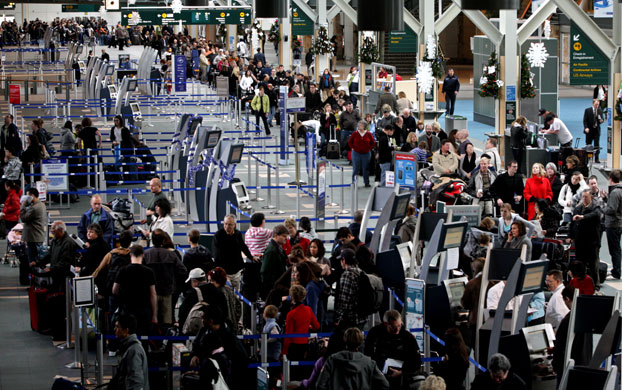
Security lines in BC, Canada. Credit: Guardian
But the effects are not only felt here in the U.S., they have hit millions of people around the world in ways we could never imagine. Obviously, security measures were upped at international airports, too, and foreign carriers changed their policies and procedures to adapt to the lower demand for air travel. But the heightened security adopted after 9/11 has discouraged many tourists from coming to America, hurting job growth in the hospitality industry. The government has created unweildy entry procedures for visitors, like lengthened wait times for visas to enter the country. Our country is in desperate need of more foreign visitors to help stimulate spending and feed money into our economy, but the backlog of visa applications has deterred a lot of travelers. In Brazil, for example, waiting periods can exceed four months. That kind of delay could cost our country hundreds of thousands of potential visitors who will choose to spend their money in other countries that do not force them to go through such a difficult and expensive process.

I realize that most of the changes have been made to keep us and our country safe, and overall, I feel we are relatively safe. But I admit that I still get irritated by the flying experience sometimes, as I'm sure we all do. I hate paying extra fees for bags, and then worrying about getting overhead space if I choose not to check. I hate when the security lines are so long that even though you give yourself enough time to make your flight, you still might cut it close.

Remembering 9/11 Credit: MSN.com
What I truly hate the most is the uneasiness that can still come when getting on a plane, the fear of not knowing whether or not you are truly safe. The acts of September 11 left an impression on all Americans, whether we had a direct connection or not. While watching the special coverage at the memorial site in New York, NBC showed a montage of video clips and images from the attacks, and I couldn't help but cry. There remains an overwhelming sadness associated with that day, because it showed how vulnerable our country can be and how far we still have to go. Our country will never get over what happened, never forget the innocent people who lost their lives, and will continue to fight for our freedom and safety, no matter what kind of small inconveniences that might bring about. It's all worth it in the end.