A credit card offer came in the mail for me the other day. Most of us are familiar with direct mail marketing from banks, credit card companies, airlines, etc. Businesses spend thousands of dollars to send out hundreds of thick envelopes filled with fancy fliers and booklets detailing all the great perks that come with signing up for this checking account or joining that frequent flier program. This is all done in the hopes of getting some return on investment, which, for many companies, could be as few as one person per 50 mail pieces. (Yes, that's considered a successful campaign.
Like most people, I usually toss these in the trash without even bothering to break the seal. But this one made me stop. It was from United Airlines--of which I am a frequent flier member--and it was for their MileagePlus Club Card. The special offer was, if I signed up now, I could get the card for a $0 introductory annual fee for the first year. The perks: A United Club membership, which grants unlimited access to all United Club locations and Star Alliance lounges; 50% mileage bonus, which means earning 1.5 miles per dollar spent and two miles per dollar spent on tickets purchased from United; Premier Access services, allowing for priority check-in and boarding; two free checked bags for me and a companion; and no foreign transaction fees. A pretty sweet deal, if you ask me.
Now, I already have a really good rewards credit card--in fact, it ranks in the top 10 best airline credit cards on Bankrate.com--which gets me points and rewards that I can redeem for travel whenever I want. However, it does not offer these kinds of travel privileges. So I thought to myself, maybe it's time to get a dedicated airline card that gives me some bonuses? My parents have the platinum card from United, but they fly all the time and my dad has a ton of miles earned from his days as a loyal Continental flier. I don't travel as often, usually about three or four times a year on average. However, the fact that those few times I do travel could be made better with this card definitely made it more appealing. Another aspect I like is that this card was named "best credit card" by Global Traveler Magazine in 2012.
Then I read an article on CNN with tips to savvy travel. One woman talked about using miles to get where you want to go, and using a rewards credit car to help earn and save up miles that can be put towards more expensive trips down the road. She used a Delta Skymiles card, which works well for her, but every person is different. While the sign-up bonus is nice, and the priority boarding and club access definitely sweeten the deal, it's the mileage earnings that are really important. Since I don't travel as often as some other people, the fact that this card gives me extra miles for daily purchases is certainly helpful.
The only off-putting part of this card is the annual fee--a whopping $395! The offer gets me the first year free, but once that time has expired, I would have to decide if the card is worth the price or decide to give it up or downgrade. Luckily, there is a perfectly good downgraded option, the MileagePlus Explorer Card, with an annual fee of $95--much more reasonable. Perks: first checked bag free; double miles on tickets and one mile per dollar spent on other purchases; priority boarding privileges; no foreign transaction fees; miles don't expire; and two one-time passes every year to the United Club. Obviously not as great as the Club card, but still decent.
And so this one time, I decided not to throw away the offer.
I'm not suggesting that you sign up for every deal that arrives in your mailbox, because that would not be smart, and could seriously hurt your credit history. And, let's face it, some are not all that good when you think look at the fine print. Some can sound like total scams--and might actually be scams. However, if you're looking to sign up for a good credit card that gets you nice travel rewards or other perks, definitely keep your eye on the mail, as many of these great deals can slip through the cracks--and into your trash. If you want a good list of top reward and travel cards, check out bankrate's website.
Showing posts with label United Airlines. Show all posts
Showing posts with label United Airlines. Show all posts
Friday, July 5, 2013


Friday, June 21, 2013
Another Quick Travel News Update
As most of you know by now, I'm on the internet pretty much all day looking at news stories. So, naturally, I see a lot of intriguing travel stories. And it is only right that I pass on these little nuggets of information to all my loyal readers, so they are aware of what is going on in the industry.
United adds requirements for elite flier status
I received an email today from United informing me of changes to qualifications for the MileagePlus program. Turns out, United added a minimum annual spending level that passsengers have to meet in order to qualify for elite frequent-flier status. At this point, I think I'm still on the low-end of the spectrum (think it's silver, but I'll have to double check), and that won't be affected this year. But starting in 2014, United fliers will have to spend at least $2,500 a year on tickets to qualify for the lowest Premier Silver status in 2015. The company kept the rule requiring passengers to fly 25,000 miles or 30 segments in a year to qualify for Silver. Of those 30, at least four have to be paid flights on United, United Express or Copa Airlines.
For Gold Status, you must spend $5,000 and fly 50,000 miles or 60 segments; while the Platinum level requires $7,500 and 75,000 miles or 90 segments. For the highest level, Premier 1K, you must spend $10,000 and fly 100,000 miles or 120 segments (a pretty steep requirement, if you ask me).
This is United's way of making elite status harder to attain, especially for fliers who purchase inexpensive tickets just to get miles. It is also a way to offer better access to benefits for customers who truly fly and spend the most, considering these customers are the ones that bring in the most money for airlines.
Planes could move to touch-screen controls
At the Paris International Air Show, new designs for touch screen controls were unveiled, and could appear in planes before the end of the decade, if the technology is implemented quickly. The tablet-like displays would make airplane controls more intuitive and user-friendly. The idea is that pilots will be able to perform basic commands, such as changing course or controlling the engine, by tapping or dragging icons on a screen. They will be able to expand navigation charts on the same screen, incorporate messages from air-traffic control, and troubleshoot malfunctions. Pilots would most likely still use a joystick to drive to perform flight controls, but other tasks could be done on the touch screens.
The new concept from Thales SA is called Avionics 2020 and was showcased at a mock-up cockpit at the Air Show, as it seeks to sign deals with aircraft manufacturers to install the technology in future planes. Honeywell said it won a contract to supply a limited system on the newest commuter jets from Embraer SA. Rockwell Collins Inc., also very aggressive on the benefits of touch screens, hopes to capitalize on the potential market.
Of course there are concerns about changing cockpit technology to touch screens. Some experts are worried about the difficulty of using the screens during severe turbulence. There are also questions about emergency commands getting lost in various menus.
International Travelers to the U.S. hit record spending in April
Spending by international visitors to the U.S. totaled nearly $14.5 billion, an increase of more than 5% from the same month the year before, according to the U.S. Department of Commerce. Between January and April of 2013, international tourists have spent about $57.9 billion on travel related services in the U.S., up 8% from the year before. Purchases of travel and tourism related services in April totaled $11.2 billion, this includes food, lodging, recreation, gifts, entertainment, local transportation and other items. U.S. carriers received $3.3 billion in fares for the month from international travelers.
In 2012, international spending reached a record $168.1 billion, up 10% from 2011. This was due to a surge in visitors, with a record 67 million international travelers coming to the U.S. Canada sent the most visitors, with 22.7 million; and Mexico had 14.5 million travelers to the U.S., coming in second. The U.K., Japan and Germany rounded out the top five.
The Best Bank for Travelers
When people plan a trip, they research flight and hotel costs to find the best deals. But a travel expense that is often overlooked is bank fees. More often than not, when people travel, they go to a place that may not have their bank ATM, especially in places overseas. Using an out-of-network ATM results in a fee, usually, and those are even more at international ATMs. And using a debit card overseas can result in a foreign transaction fee of up to 3% of the amount.
But some banks are more travel-friendly than others. M&T Bank has the highest out-of-network ATM fee ($3) of 20 U.S. banks measured by Nerdwallet. The bank also has a 3% foreign exchange fee. It also has the fewest number of branches across the most traveled states. The best bank for travelers is TD Bank, which has one of the lowest fees for ATMs ($2.50), and has no foreign exchange fee, the only one that doesn't have one. It also has a decent number of branches across the country. Citibank, Capital One, BBVA Compass, and BMO Harris Bank round out the top five best banks for travelers.
TripAdvisor acquires GateGuru
TripAdvisor made yet another acquisition this week, buying GateGuru, a mobile app that provides real-time information on airports, weather, and flights. Most of that is from crowdsourcing. The deal is a direct expansion of TripAdvisor's services, especially as more people turn to mobile and social networks to get travel feedback. The team behind GateGuru will remain in New York and continue to operate the way it did before the purchase, it will just report to the GM of new initiatives and leader of the TripAdvisor Flights product and the SeatGuru brand.
TripAdvisor recently bought mobile/social startup, TinyPost, in March, followed immediately by JetSetter and then CruiseWise in May. In October 2012, TripAdvisor acquired Wanderfly.
Hampton targets Millennials
Hampton Hotels launched a new advertisement targeting Millennials. The commercial shows Millennial social media users as they stayed at nine Hampton locations and were encouraged to share their experiences on different social media platforms. The commercial follows their weekend trips through pictures, videos, check-ins and status updates. The idea is to convey that Hampton is a young brand and can relate to the tech-savvy and social Millennial generation.
Guide to Visiting Turkey
Recently, there were some anti-government protests in Turkey over the future of a park in Istanbul. It all started as a peaceful protest, but soon erupted into what some people call a "war zone," with police using violence and force to stop demonstrations. The continued government retaliation and unrest is certainly worrisome, but these events should not deter people from visiting the country. Tourists should avoid demonstrations in Istanbul and be alert to potential violence. Travelers who have been in the city or decided to keep their plans to visit said Istanbul feels safe, and most said they felt neither threatened nor endangered.
Taksim Square, where the protests are taking place, is just one location in the city, and most of the major attractions are further away from the Square, so it is easily avoidable. Still, on June 4, the State Department put Turkey on its list of Travel Alerts, which basically advises Americans to be aware of the situation, and avoid being hurt as innocent bystanders. Many unions have threatened strikes that could hurt travel, but the alert is set to expire on July 5.
This is certainly good news, since tourism is crucial to Istanbul and the whole Turkish nation. In fact, the city is one of the fastest growing tourism markets in the world. It's also positive for me, since my boyfriend and I are thinking of visiting Turkey sometime soon. We still haven't figured out exact dates or anything, but hopefully, by the time we go, the protests and rallies will have fizzled out, and we can enjoy all this eclectic, historic city has to offer.
United adds requirements for elite flier status
I received an email today from United informing me of changes to qualifications for the MileagePlus program. Turns out, United added a minimum annual spending level that passsengers have to meet in order to qualify for elite frequent-flier status. At this point, I think I'm still on the low-end of the spectrum (think it's silver, but I'll have to double check), and that won't be affected this year. But starting in 2014, United fliers will have to spend at least $2,500 a year on tickets to qualify for the lowest Premier Silver status in 2015. The company kept the rule requiring passengers to fly 25,000 miles or 30 segments in a year to qualify for Silver. Of those 30, at least four have to be paid flights on United, United Express or Copa Airlines.
For Gold Status, you must spend $5,000 and fly 50,000 miles or 60 segments; while the Platinum level requires $7,500 and 75,000 miles or 90 segments. For the highest level, Premier 1K, you must spend $10,000 and fly 100,000 miles or 120 segments (a pretty steep requirement, if you ask me).
This is United's way of making elite status harder to attain, especially for fliers who purchase inexpensive tickets just to get miles. It is also a way to offer better access to benefits for customers who truly fly and spend the most, considering these customers are the ones that bring in the most money for airlines.
Planes could move to touch-screen controls
At the Paris International Air Show, new designs for touch screen controls were unveiled, and could appear in planes before the end of the decade, if the technology is implemented quickly. The tablet-like displays would make airplane controls more intuitive and user-friendly. The idea is that pilots will be able to perform basic commands, such as changing course or controlling the engine, by tapping or dragging icons on a screen. They will be able to expand navigation charts on the same screen, incorporate messages from air-traffic control, and troubleshoot malfunctions. Pilots would most likely still use a joystick to drive to perform flight controls, but other tasks could be done on the touch screens.
The new concept from Thales SA is called Avionics 2020 and was showcased at a mock-up cockpit at the Air Show, as it seeks to sign deals with aircraft manufacturers to install the technology in future planes. Honeywell said it won a contract to supply a limited system on the newest commuter jets from Embraer SA. Rockwell Collins Inc., also very aggressive on the benefits of touch screens, hopes to capitalize on the potential market.
Of course there are concerns about changing cockpit technology to touch screens. Some experts are worried about the difficulty of using the screens during severe turbulence. There are also questions about emergency commands getting lost in various menus.
International Travelers to the U.S. hit record spending in April
Spending by international visitors to the U.S. totaled nearly $14.5 billion, an increase of more than 5% from the same month the year before, according to the U.S. Department of Commerce. Between January and April of 2013, international tourists have spent about $57.9 billion on travel related services in the U.S., up 8% from the year before. Purchases of travel and tourism related services in April totaled $11.2 billion, this includes food, lodging, recreation, gifts, entertainment, local transportation and other items. U.S. carriers received $3.3 billion in fares for the month from international travelers.
In 2012, international spending reached a record $168.1 billion, up 10% from 2011. This was due to a surge in visitors, with a record 67 million international travelers coming to the U.S. Canada sent the most visitors, with 22.7 million; and Mexico had 14.5 million travelers to the U.S., coming in second. The U.K., Japan and Germany rounded out the top five.
The Best Bank for Travelers
When people plan a trip, they research flight and hotel costs to find the best deals. But a travel expense that is often overlooked is bank fees. More often than not, when people travel, they go to a place that may not have their bank ATM, especially in places overseas. Using an out-of-network ATM results in a fee, usually, and those are even more at international ATMs. And using a debit card overseas can result in a foreign transaction fee of up to 3% of the amount.
But some banks are more travel-friendly than others. M&T Bank has the highest out-of-network ATM fee ($3) of 20 U.S. banks measured by Nerdwallet. The bank also has a 3% foreign exchange fee. It also has the fewest number of branches across the most traveled states. The best bank for travelers is TD Bank, which has one of the lowest fees for ATMs ($2.50), and has no foreign exchange fee, the only one that doesn't have one. It also has a decent number of branches across the country. Citibank, Capital One, BBVA Compass, and BMO Harris Bank round out the top five best banks for travelers.
TripAdvisor acquires GateGuru
TripAdvisor made yet another acquisition this week, buying GateGuru, a mobile app that provides real-time information on airports, weather, and flights. Most of that is from crowdsourcing. The deal is a direct expansion of TripAdvisor's services, especially as more people turn to mobile and social networks to get travel feedback. The team behind GateGuru will remain in New York and continue to operate the way it did before the purchase, it will just report to the GM of new initiatives and leader of the TripAdvisor Flights product and the SeatGuru brand.
TripAdvisor recently bought mobile/social startup, TinyPost, in March, followed immediately by JetSetter and then CruiseWise in May. In October 2012, TripAdvisor acquired Wanderfly.
Hampton targets Millennials
Hampton Hotels launched a new advertisement targeting Millennials. The commercial shows Millennial social media users as they stayed at nine Hampton locations and were encouraged to share their experiences on different social media platforms. The commercial follows their weekend trips through pictures, videos, check-ins and status updates. The idea is to convey that Hampton is a young brand and can relate to the tech-savvy and social Millennial generation.
Guide to Visiting Turkey
Recently, there were some anti-government protests in Turkey over the future of a park in Istanbul. It all started as a peaceful protest, but soon erupted into what some people call a "war zone," with police using violence and force to stop demonstrations. The continued government retaliation and unrest is certainly worrisome, but these events should not deter people from visiting the country. Tourists should avoid demonstrations in Istanbul and be alert to potential violence. Travelers who have been in the city or decided to keep their plans to visit said Istanbul feels safe, and most said they felt neither threatened nor endangered.
Taksim Square, where the protests are taking place, is just one location in the city, and most of the major attractions are further away from the Square, so it is easily avoidable. Still, on June 4, the State Department put Turkey on its list of Travel Alerts, which basically advises Americans to be aware of the situation, and avoid being hurt as innocent bystanders. Many unions have threatened strikes that could hurt travel, but the alert is set to expire on July 5.
This is certainly good news, since tourism is crucial to Istanbul and the whole Turkish nation. In fact, the city is one of the fastest growing tourism markets in the world. It's also positive for me, since my boyfriend and I are thinking of visiting Turkey sometime soon. We still haven't figured out exact dates or anything, but hopefully, by the time we go, the protests and rallies will have fizzled out, and we can enjoy all this eclectic, historic city has to offer.
Monday, February 13, 2012
Yet Another Way to Earn Miles
We've all done it. Forgotten that we had a gift card to a retailer or never used the full amount on the card. Now you're left with funds that will most likely go unused, money down the drain. Well, if you're a United MileagePlus member, you are in luck.
United Continental wants your unused gift cards...and in return, you get miles.
Sounds like a pretty sweet deal to me.
The airline just launched a new program that will reward members of its frequent-flier program with miles in exchange for their unused gift cards. United said the program was the first of its kind.
There are more than 60 retailers participating--Barnes & Noble, Home Depot, Pottery Barn, to name a few. Members just log on to their accounts, find the retailer for their card and enter the information. The amount left on the card will be converted to miles and deposited in their account. There is a minimum balance of $25, and cards cannot be combined to reach that limit.
To learn more about the program, check out the website.
Tuesday, August 16, 2011
On Planes, Passengers Indulge
I've written a few posts about trying to stay active and eat healthy while traveling, since it is often difficult to maintain that lifestyle while on the road. Many people constantly ask how they can keep up with their diets or avoid packing on pounds while on vacation, so it seems oddly counterproductive to find out that most passengers will still choose the high-fat and calorie-laden items on airplane menus. What is going on here?
 I read an article in the Wall Street Journal that critiques airplane food and discusses what people are choosing to eat onboard. While many carriers have tried to introduce healthy items like fresh salads, hummus plates, fruit and nut mixes, and greek yogurt, passengers seem to pass those over for something a bit more indulgent. For example, Alaska Airlines offers vegan and gluten-free items, and chicken and vegetable dishes. Yet, it's most popular item is the quarter-pound cheeseburger. United Airlines briefly had "active" and "organic" snack boxes, but ended up donating most of the food. In the end, it had to eliminate the items from the menu because they just were not selling. According to the airline, the most popular option is the "tapas" snack box, which has nine different items, like crackers, hummus, olives, cheese, almonds and candy, and weighs in at 553 calories. If experiments with healthy options seem to be failing as passengers decide to reach for salty, carb-ridden foods, what's the point of having them anyway?
Because there will always be at least one person on the plane that will choose the better product. But in all honesty, most airlines still fill menus with food that is not particularly good for you, even though they are making some moves in the right direction. Airlines like Delta still sell items like toffee-caramel popcorn or cans of Pringles sour cream-and-onion chips, which adds up to 375 calories. United's "Classic Snack Box" features both goldfish and pretzels, why do you need both?
 Food experts say that many of these snack boxes contain between 600 and 700 calories, mostly because they are stuffed with a variety of different items that most people probably do not need. A turkey sandwich comes in at a reasonable 400 calories, but throw in potato chips, cookies, almonds and dried fruit, and you just bumped it up by another 300 calories or so. And since airlines do not print up the calorie counts for people, travelers believe they are consuming healthy options, when they really aren't. Since carriers cannot seem to sell beneficial food items, they are forced to either riddle them with more salty, high-calorie foods or remove them from menus all together.
 For those who don't think twice about what they eat on planes, these options will suffice. But for those who are concerned about what they eat or are trying to maintain a diet or watch their waists, I suggest surpassing the food that airlines provide. The best thing you can do is pack your own food. It's easy to make a small sandwich and bring it on board, or pack small snacks like fruit, cheese and nuts. It's a safer bet calorie-wise, and it also saves you about $10.

Because there will always be at least one person on the plane that will choose the better product. But in all honesty, most airlines still fill menus with food that is not particularly good for you, even though they are making some moves in the right direction. Airlines like Delta still sell items like toffee-caramel popcorn or cans of Pringles sour cream-and-onion chips, which adds up to 375 calories. United's "Classic Snack Box" features both goldfish and pretzels, why do you need both?

Friday, February 25, 2011
Airline Lounges: How to Get in When You Are Not a Member
Airport lounges have always elicited an aura of exclusivity, with only a select few being allowed to walk the red carpet and pass through the gold-trimmed doors. But the days of member only access are long gone, and now anyone can get into these so-called VIP lounges, if they are willing to pay.
Airport lounges may be pricey, but at times they are definitely worth the money. Lounges have comfortable chairs and workstations, free beverages and snacks, and airline representatives. Annual admissions fees, however, can range between $450 and $500, which might be too much for people who are not frequent fliers. For those who are sporadic travelers, there are options. Day passes for American Admiral's Club, Continental's Presidents Club, Delta's Sky Club and United's Red Carpet Club can be bought for $50 per person. Delta offers discounted prices for people who have Gold or Platinum airline American Express card, and also has a 30-day membership for $90 as a trial offer.United lets you print off $35 dollar day passes from home to be used at a United Red Carpet Club or Continental Presidents Club.
Annual memberships can be bought using money or frequent flier miles. Delta, US Airways and Alaska sell them for $450, Continental and United offer them at $475, and American has them for $500. Several of these memberships offer reciprocal admission to other airline lounges, meaning you may have a Delta membership but you have access to Alaska Board Rooms.
Amenities in each lounge will vary, including an open bar, snacks, free wireless, comfortable seating and the ability to bring in two guests. Clubs also have airline representatives available to help you deal with flight cancellations or delays, and the lines are much shorter in the lounge than at the customer service desk.
There are also non-airline airport club programs. Priority Pass gives you entry to 600 lounges worldwide. Memberships cost $99 annually, plus $27 a visit or $399 annually with unlimited visits. This is one of the best options because it gives you a broad range of choices, rather than limiting you to one airline lounge--plus you can check out all of them if you want and gauge which one has the best amenities. American Express Platinum Card airport club program and Diners Club cards give you access to a number of different lounges as well, but come with a few more limitations and less choices than the Priority Pass.
No matter what option you choose, you'll get a pretty decent deal out of it, especially if you find yourself at the airport on a regular basis. I know that once I start traveling more, I am definitely getting a membership to the lounges, because the few experiences I have had with them have been heavenly.
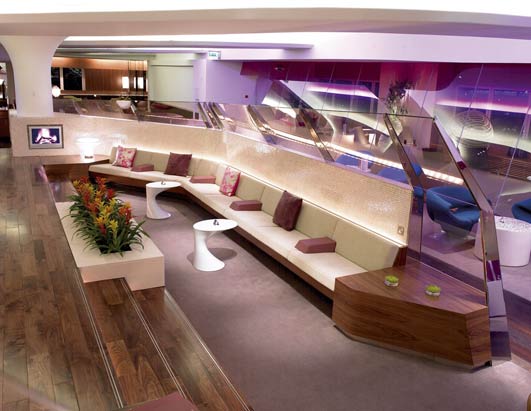 |
| Virgin Atlantic Lounge at Heathrow |
Annual memberships can be bought using money or frequent flier miles. Delta, US Airways and Alaska sell them for $450, Continental and United offer them at $475, and American has them for $500. Several of these memberships offer reciprocal admission to other airline lounges, meaning you may have a Delta membership but you have access to Alaska Board Rooms.
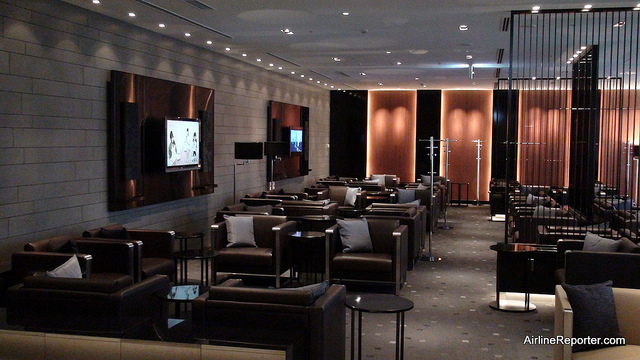 |
| United Airlines Lounge |
There are also non-airline airport club programs. Priority Pass gives you entry to 600 lounges worldwide. Memberships cost $99 annually, plus $27 a visit or $399 annually with unlimited visits. This is one of the best options because it gives you a broad range of choices, rather than limiting you to one airline lounge--plus you can check out all of them if you want and gauge which one has the best amenities. American Express Platinum Card airport club program and Diners Club cards give you access to a number of different lounges as well, but come with a few more limitations and less choices than the Priority Pass.
No matter what option you choose, you'll get a pretty decent deal out of it, especially if you find yourself at the airport on a regular basis. I know that once I start traveling more, I am definitely getting a membership to the lounges, because the few experiences I have had with them have been heavenly.
Wednesday, January 26, 2011
Is Flying Just Another Form of Public Transportation?
 |
| Courtesy of Wellcultured.com |
 |
| From flickr, by mark_v_socal |
I find this revelation to be rather sad, because I truly enjoy flying. I love knowing that I am going to be on a plane, traveling somewhere different, or perhaps someplace familiar--it all depends on my travel plans. But the fact is, I still get excited to board a plane, to watch the airport grow smaller as we ascend into the air, to feel the drop in my stomach as the wheels go up and the plane is floating. I still think of it as something special. And yet I know there are few who feel the way I do about having to fly. They look at it as a chore, an obligation to get them to their destination. It's uncomfortable, frustrating, expensive, and they just want it over with as soon as possible. So what can be done?
 |
| From Flickr, by mark_v_socal |
While these amenities certainly bring back some memories of the early days of air travel when passengers were excited about flying and truly enjoyed their experience on planes, it does not mean that Virgin America will prosper, especially with other airlines doing their best to make sure it fails. But if Virgin's ways cannot get them to the top of the airline industry, they are at least pushing other airlines to instill some of these concepts on their planes. In fact, Delta and United are already starting to install Wi-Fi on their flights, Continental is looking into satellite television and mood-lighting is being put into many of Boeing's new models.
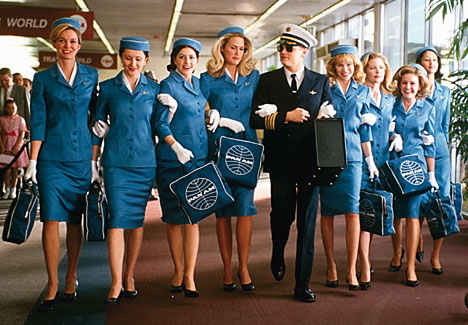
Even if the days of stewardesses, smartly dressed business men, luxury seating and impeccable service are long gone, there is still hope that air travel will not lose its cache. And if airlines like Virgin America continue to keep the passenger as their main focus, we might be welcoming a whole new era of air travel, where--hopefully--the champagne will be flowing.
Subscribe to:
Posts (Atom)